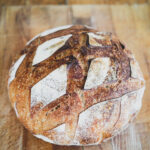
Easy Sourdough Bread
This is a really easy to make sourdough recipe inspired by the Tartine Bread method
Yield: 2 Loaves
Cost: £1.00
Equipment
- Bowl
- Dough scraper
- Scales
- Measuring jug
- Bannetons
- Casserole Dish
- Lame
Materials
Levain
- 50 g Sourdough Starter
- 40 g Bread flour
- 40 g Wholemeal flour
- 80 g Tepid water
Bread Recipe
- 700 ml Tepid Water
- 1 unit Sourdough levain (see above)
- 900 g Strong white bread flour
- 100 g Wholemeal flour
- 50 g Tepid water
- 20 g Salt
Instructions
For the levain
- First make the levain the night before combining the flour, water & sourdough starter
For the bread
- Combine the prepared levain and water.
- Add flour to mixed levain to form a rough dough ball.
- Leave for 30 minutes
- Add solution of 50g tepid water and 20g salt and press it in to the dough
- Grab a side of the dough and fold it into the middle repeat 7-8 times grabbing a new section each time. Leave for 25 minutes.
- Repeat the above step two more times leaving for 25 minutes each time. On the third fold flip the ball of dough over so the folds are underneath.
- First coil fold, put your hands under the dough and lift out of the bowl, fold the dough in on itself. Twist and repeat three more times. Leave for 25 minutes.
- Second coil fold, repeat above and leave for another 25 minutes.
- Tip the dough out on to a lightly floured work surface and divide in to two pieces. Handle carefully as you don't want to lose the air you've worked so hard to get in there.
- Form in to taught balls by dragging toward you with dough scraper several times (you'll start to feel the tension build.
- Leave for 30 minutes.
- Lightly flour the top of each ball of dough then flip over, stretch the dough out slightly until you have a rectangle fold the bottom up to half way then fold the sides in so they overlap. Then grab the top corners and slightly stretch out until you have ears then bring them over the bottom corners to reform a ball. Repeat the dragging towards you to get more tension, flour the top and flip into a prepared banneton basket or suitable bowl/sieve lined with a clean floured tea towel. Let rest for 30 minutes then transfer to fridge to prove over night.
- The following morning heat your dutch oven in the hottest oven possible. Flip you bread out of the container onto some baking parchment slice the top with a bread lame or razor blade transfer to the dutch oven.
- Bake for 20 minutes with the lid on remove the lid then bake for a further 20 minutes 220°c/Gas Mark 7 or until golden brown with slight tinges of black.
- Let cool.
Notes
Although the time for this recipe looks a lot the actual hands on time is very short, it's a kind of mix and forgot letting the natural raising agent in the starter do its job.
I've found that it is a very temperature dependent process that has become fool proof once utilising the fridge to control the rate of proving.